You walked into the spare room with two dumbbells and a vague plan to train your chest. There’s no bench. There’s never going to be a bench in this room. So you searched for a home dumbbell chest workout no bench could ruin, found the same five “floor press, push-up, done” articles everyone else has written, and closed your laptop unsure if any of it would actually move the needle.
Here is what nobody is telling you. The lifters who train in commercial gyms with adjustable benches and dumbbell racks running to the eighties — a non-trivial number of them program floor pressing on purpose. Westside-influenced powerlifters use it as a lockout exercise. Old-school strongmen built their chests on it before flat benches were standard equipment. Your floor isn’t a workaround. It’s a different stimulus, with measurable advantages, and once you know how to use it, the bench you don’t have stops mattering.
What follows is a complete home dumbbell chest workout no bench programme — built around what the floor does uniquely well, run twice a week, and scalable for years on the dumbbells you already own. Read the next section before the workout. The reasoning is what makes the lifts work.
Why Pros Floor Press on Purpose
The bench press lets your elbows drop below the line of your torso. This stretches the pec deep, demands aggressive shoulder rotation, and is — empirically — where most pressing-related shoulder injuries actually happen. A cross-sectional study of 104 competitive powerlifters found that 56% of current shoulder injuries started during bench press training. The bottom of the press is where the joint is most exposed to abduction and external rotation under heavy load.
The floor press gives you the top half of the rep without the bottom-half exposure. Your elbows stop where the floor stops them, usually at or just above the line of your torso. Three things follow from this:
You can press heavier with less shoulder cost. Less range of motion means less time in the vulnerable abducted-and-externally-rotated position. Less time there means more confidence to load.
Your triceps work the entire rep. There is no chest-and-shoulder-stretch position to let your triceps coast at the bottom. From elbow-on-floor to lockout, the long head fires the whole way.
You can’t cheat with leg drive. You’re flat on the ground. Whatever you press is pressed honestly, by the muscles in question, with no momentum borrowed from your hips. For a setup where there’s no spotter and no power rack, that honesty is also a safety feature.
That is why a properly designed home dumbbell chest workout no bench setup is closer to a free upgrade than a compromise. The floor is taking work off your shoulders and putting it on the muscles that should be doing the pressing.
The Home Dumbbell Chest Workout No Bench Plan
This is the home dumbbell chest workout no bench setup actually needs, written to run twice a week with at least 48 hours between sessions. Total time: 30–35 minutes including the warm-up. Don’t skip it.
Warm-up (3 minutes). Twenty band pull-aparts, ten scap push-ups, ten slow push-ups. The floor press starts harder than a bench press because there’s no eccentric ramp into the bottom — your tissue should already be primed before the first working rep.
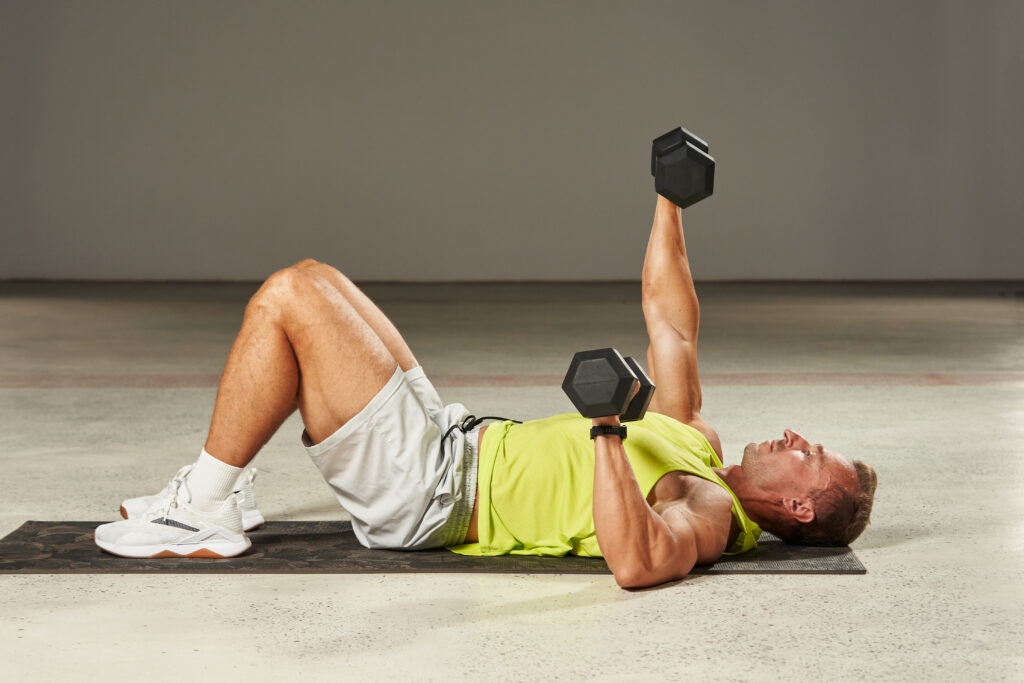
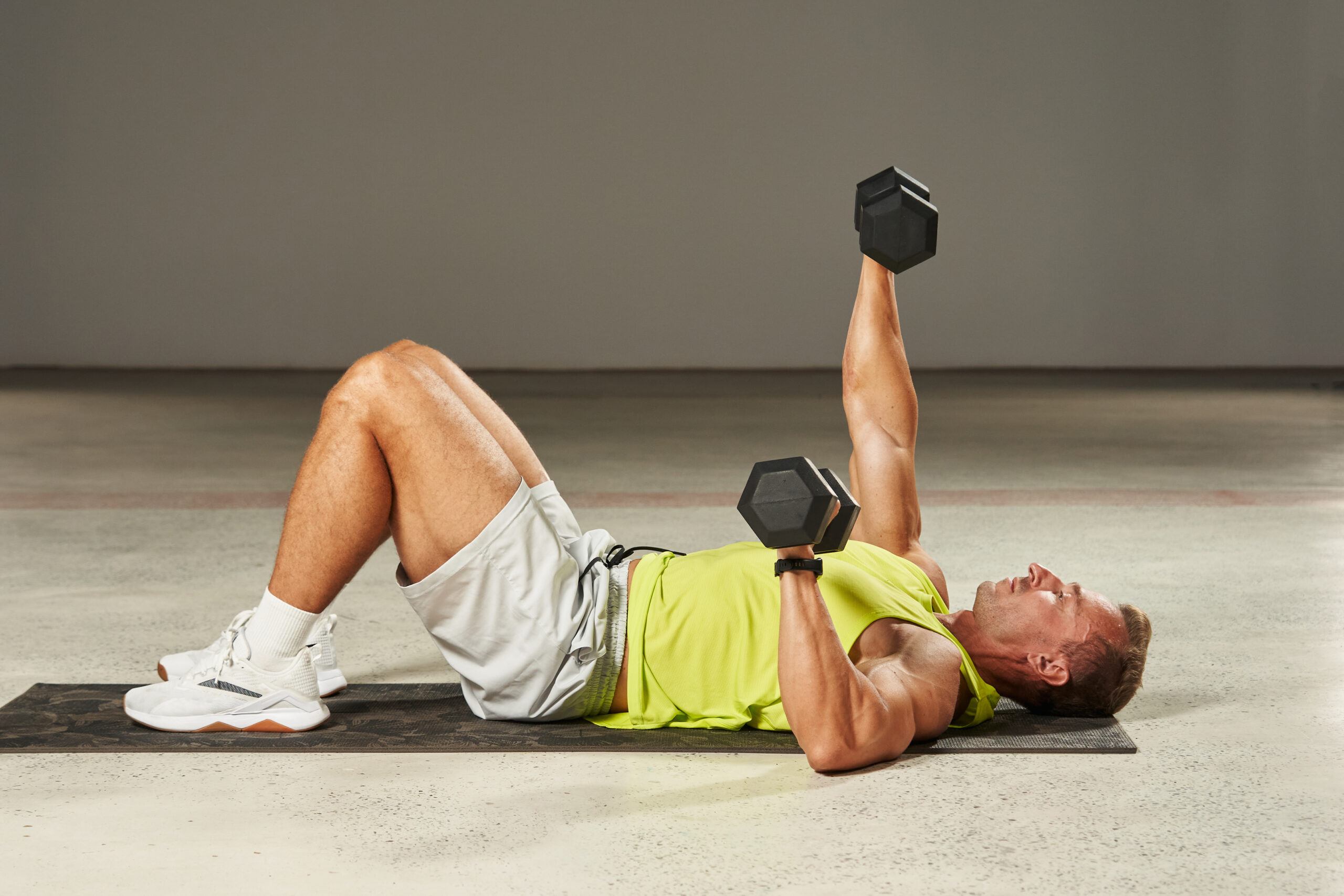
1. Dumbbell floor press — 4 sets of 6–8 reps. Lie flat. Knees bent or legs straight, your call. Start with the dumbbells on your belly and curl them into position over your shoulders. Lower under control until your triceps just touch the floor, pause for a beat, and press up. The pause is what makes this lift honest. No bouncing the elbows off the ground.
2. Dumbbell floor flye — 3 sets of 10–12 reps. Same starting position. Slight bend in the elbows, lock it, and lower the dumbbells out wide. Stop when your upper arms touch the floor. Squeeze back up as if you’re hugging a tree. The floor protects you from going too deep — take that as permission to stay light and chase the contraction, not the load.
3. Squeeze press — 3 sets of 12–15 reps. Dumbbells touching each other on your chest, neutral grip, palms facing in. Press straight up while actively pushing the dumbbells into each other through the entire rep. This is the lift that hammers the inner-pec contraction the floor press by itself doesn’t reach.
4. Deficit push-up — 3 sets to two reps shy of failure. Hands on the dumbbells, body lower than your hands, going deeper than a normal push-up allows. This is your stretch-position chest work — the one thing a home dumbbell chest workout no bench programme has to add back deliberately to compensate for what the floor cuts off.
Rest two minutes between sets on the floor press, ninety seconds on flyes and squeeze presses, sixty seconds on push-ups.
Making This Home Dumbbell Chest Workout No Bench Keep Producing
Most people who try a home dumbbell chest workout no bench routine quit after six weeks. Their dumbbells max out, they assume they’ve hit a ceiling, and they go shopping. They haven’t hit a ceiling. They’ve hit the ceiling of the most obvious form of progressive overload — adding weight — and ignored the four others sitting next to it.
Tempo. Lower the dumbbells over a four-count instead of a two-count. Pause at the floor for a full second. Same weight, twice the time under tension, real new stimulus.
Density. Run the same sets with thirty seconds less rest. When your old workout takes ten minutes less to complete with the same weights and reps, that is progress, even though the spreadsheet doesn’t say so.
Pause reps. On the floor press, hold the bottom for a three-count before pressing. This eliminates any rebound off the ground and forces every rep to start from a true dead stop.
1.5 reps. Press up halfway, lower back to the floor, then press all the way up. That is one rep. Cuts your effective load by about 30% and roughly doubles the burn.
Unilateral. One dumbbell at a time. Your 50s suddenly feel like 80s, your core is on fire stabilising the asymmetric load, and you’ve just added another six months of meaningful progression to the kit you already own.
The home dumbbell chest workout no bench you do today does not have to be the workout you do in six months. Every variable except the equipment is yours to manipulate.
When the Floor Isn’t Enough
Honest section. The one thing a home dumbbell chest workout no bench setup genuinely cannot replicate is loaded stretch in the bottom of a full bench-style range of motion. If your goal is competitive bodybuilding-grade pec hypertrophy at the highest levels, eventually you’ll want access to a bench, rings, or a deep-deficit setup. But “eventually” is further out than most people think. For most lifters training for strength, aesthetics, and being the person who can do push-ups when their kid asks them to, a home dumbbell chest workout no bench programme run with intent for two years builds a chest that announces itself through a t-shirt. The deficit push-up in this plan is your stretch-position insurance policy. Use it every session.
Frequently Asked Questions
Can you build a real chest with a home dumbbell chest workout no bench setup?
Yes. The pectoralis major responds to mechanical tension in any of its lengthened, mid-range, or contracted positions. The floor press covers mid-to-contracted, the flye covers stretch in a controlled range, the squeeze press pushes contracted to its limit, and the deficit push-up restores stretch under bodyweight load. That spans the muscle. The training that doesn’t work is half-hearted training, not bench-less training.
How heavy do my dumbbells need to be?
Heavier than you think, sooner than you think. A trained adult will run out of progress on a pair of 25-pounders faster than the marketing wants him to know. Start with what you have, but plan on a pair of fixed dumbbells in the 40–60 lb range or, ideally, an adjustable pair that runs to 70 or higher. The floor press lets you load heavier than the bench press at the same training age, and you’ll want somewhere for that strength to go.
How often should I run this workout?
Twice a week, with at least 48 hours between sessions. The floor press carries a slightly higher tricep cost than the bench press because the triceps work through the entire rep, so if you’re pressing overhead the same week, give yourself a real day off between the two sessions. Most people who fail with a home dumbbell chest workout no bench setup don’t fail on intensity — they fail on consistency and recovery. Two real sessions a week beats four mediocre ones every time.
Floor press or bench press for raw chest size?
If both are genuinely available to you, the bench press wins on stretch-position loading. If only the floor is available — which is the actual question — the gap closes considerably once you add the deficit push-up and run the home dumbbell chest workout no bench programme with progression for more than a few weeks. Most people quit before they find this out.