Starting your fitness journey can feel overwhelming, especially when it comes to learning proper squat technique. The goblet squat for beginners offers the perfect entry point into strength training, providing a safe and effective way to master foundational movement patterns. Unlike barbell squats that can intimidate newcomers, goblet squats keep the weight in front of your body, making balance easier and form corrections more natural.
This comprehensive guide will walk you through 7 essential form tips that will help you build confidence and strength from your very first workout. Whether you’re stepping into a gym for the first time or looking to perfect your technique, these proven strategies will set you up for long-term success.
Why Goblet Squats Are Perfect for New Lifters
The goblet squat for beginners serves as an ideal introduction to lower body strength training for several compelling reasons. First, holding weight at chest level naturally encourages proper posture and spine alignment, making it nearly impossible to lean forward dangerously like you might with a barbell.
This exercise teaches the fundamental squatting pattern that translates to everyday activities like sitting in chairs, picking up objects from the floor, and climbing stairs. The front-loaded position also activates your core muscles throughout the movement, providing stability training alongside leg strengthening.
Research from the American College of Sports Medicine shows that compound movements like goblet squats engage multiple muscle groups simultaneously, making them highly efficient for building overall strength and coordination in new exercisers.
The 7 Essential Form Tips for Goblet Squat Success
1. Master the Proper Weight Hold at Chest Height
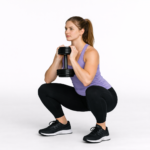
Your grip on the weight determines everything about your goblet squat execution. Hold a dumbbell or kettlebell vertically against your chest, with your hands cupping the weight from underneath. Your elbows should point downward, and the weight should rest comfortably against your sternum.
Keep your shoulders pulled back and down, creating a stable shelf for the weight. This position engages your upper back muscles and prevents the weight from pulling you forward. Start with your arms slightly bent, maintaining this angle throughout the entire movement.
2. Find Your Optimal Foot Position and Stance Width
Stand with your feet slightly wider than shoulder-width apart, toes pointed outward at approximately 15-30 degrees. This stance provides the stability needed for proper depth while accommodating most people’s natural hip anatomy.
Your weight should be evenly distributed across your entire foot, with particular attention to keeping your heels planted firmly on the ground. Avoid shifting to your toes during the descent, as this can compromise balance and reduce the effectiveness of the movement.
3. Use the Chest-Up Cue for Spine Safety
Maintaining an upright torso protects your lower back and ensures optimal muscle activation. Before beginning each repetition, take a deep breath and lift your chest toward the ceiling while pulling your shoulder blades together.
This proud chest position should be maintained throughout the entire range of motion. If you notice your chest dropping or your back rounding, pause the movement and reset your posture before continuing.
4. Track Your Elbows Between Your Knees
As you descend into the squat, your elbows should travel down between your knees rather than flaring outward. This creates a natural pathway that encourages proper knee tracking and prevents inward knee collapse.
Think of your elbows as guides that help push your knees outward, maintaining alignment with your toes. This technique promotes healthy hip mobility while protecting your knee joints from potentially harmful positions.
5. Control Your Descent and Ascent Speed
Lower yourself slowly over 2-3 seconds, maintaining control throughout the entire range of motion. This controlled descent builds strength in the lengthening phase of the movement while giving you time to make form adjustments.
Pause briefly at the bottom position, then drive through your heels to return to standing. The upward phase should be powerful but controlled, taking approximately 1-2 seconds to complete.
6. Achieve Proper Depth Safely
Descend until your hip crease is slightly below your knee level, or as low as your mobility comfortably allows. For beginners, reaching parallel (where your thighs are horizontal to the floor) is perfectly acceptable while you build flexibility and strength.
Never force depth at the expense of form. Your range of motion will naturally improve over time as your hip and ankle mobility increases through consistent practice.
7. Breathe Properly Throughout the Movement
Take a deep breath at the top of each repetition, hold it during the descent and ascent, then exhale forcefully as you reach the standing position. This breathing pattern, known as the Valsalva maneuver, creates internal pressure that stabilizes your core and spine.
Proper breathing also helps maintain focus and control throughout each repetition, preventing rushed movements that can compromise form and safety.
Starting Weight Recommendations and Progression Timeline
Begin your goblet squat for beginners journey with a weight that allows you to complete 10-12 repetitions with perfect form. For most beginners, this means starting with a 10-15 pound dumbbell or kettlebell.
Focus on mastering the movement pattern during your first 2-3 weeks before adding additional weight. Once you can perform 15 repetitions with excellent form, increase the weight by 5-10 pounds and return to the 8-10 repetition range.
A typical progression timeline for dedicated beginners looks like this: weeks 1-2 focus on form with bodyweight or light weight, weeks 3-4 add moderate resistance, weeks 5-8 gradually increase load while maintaining perfect technique, and weeks 9-12 explore variations and advanced progressions.
Cost and Equipment Considerations
One of the biggest advantages of the goblet squat for beginners is its minimal equipment requirements. A single dumbbell or kettlebell is all you need to get started, making this exercise accessible regardless of your budget or available space.
Basic dumbbells suitable for goblet squats range from $20-50 for a set of adjustable weights, while kettlebells typically cost $30-80 depending on weight and quality. Many gyms provide these tools as part of standard membership packages, eliminating upfront costs entirely.
For home workouts, consider starting with adjustable dumbbells that can grow with your strength levels. This investment typically pays for itself within 3-4 months compared to gym membership fees while providing long-term training flexibility.
Common Mistakes and How to Avoid Them
The most frequent error among beginners is allowing the knees to cave inward during the movement. This happens when hip muscles are weak or when the weight is too heavy for current strength levels. Focus on pushing your knees outward in alignment with your toes throughout the entire range of motion.
Another common mistake is rising up onto the toes during the descent or ascent. This shifts emphasis away from the powerful hip and glute muscles while placing unnecessary stress on the knees. Keep your entire foot planted firmly on the ground, driving through your heels to stand up.
Many beginners also rush through repetitions, sacrificing control for speed. Remember that slower, more controlled movements build strength more effectively while reducing injury risk. Take your time with each repetition, focusing on quality over quantity.
Finally, avoid the temptation to add weight too quickly. Progressive overload should be gradual and sustainable, prioritizing form improvements over impressive numbers on the weight plates.
Essential Tips for Long-Term Success
Consistency trumps intensity when learning the goblet squat for beginners. Aim to practice this movement 2-3 times per week, allowing at least one day of rest between sessions for proper recovery and muscle adaptation.
Video record yourself from the side angle periodically to assess your form objectively. Many movement flaws are invisible to us while performing the exercise but become obvious when viewed from an external perspective.
Consider working with a qualified personal trainer for your first few sessions to ensure proper technique establishment. According to the National Academy of Sports Medicine, proper initial instruction significantly reduces injury risk and accelerates skill development in new exercisers.
Warm up thoroughly before each goblet squat session with 5-10 minutes of light cardio and dynamic stretching. This preparation increases blood flow to working muscles and improves joint mobility for safer, more effective training.
Track your progress in a workout journal, noting weights used, repetitions completed, and any form observations. This documentation helps identify patterns and ensures consistent progression over time.
Building Confidence Through Gradual Progression
The journey to mastering the goblet squat for beginners requires patience and self-compassion. Every expert lifter started exactly where you are now, learning these same fundamental movement patterns through dedicated practice and gradual improvement.
Celebrate small victories along the way, whether that’s adding your first 5 pounds, achieving deeper range of motion, or simply feeling more confident in your technique. These incremental improvements compound over time, leading to significant strength and skill developments.
Remember that perfect form is more valuable than heavy weight, especially during your first months of training. Focus on building solid movement foundations now, and the strength gains will follow naturally as your body adapts to the training stimulus.
With these 7 essential form tips as your guide, you’re well-equipped to begin your strength training journey safely and effectively. The goblet squat will serve as a cornerstone exercise that builds the foundation for more advanced movements while delivering immediate benefits for your overall fitness and daily life activities.